Kling 3.0 vs 2.6: What Actually Changed
Kuaishou shipped Kling 3.0 on Feb 4, 2026. You get unified multimodal, 15s clips, native audio in five languages, and a +52 Elo jump over 2.6 Pro.
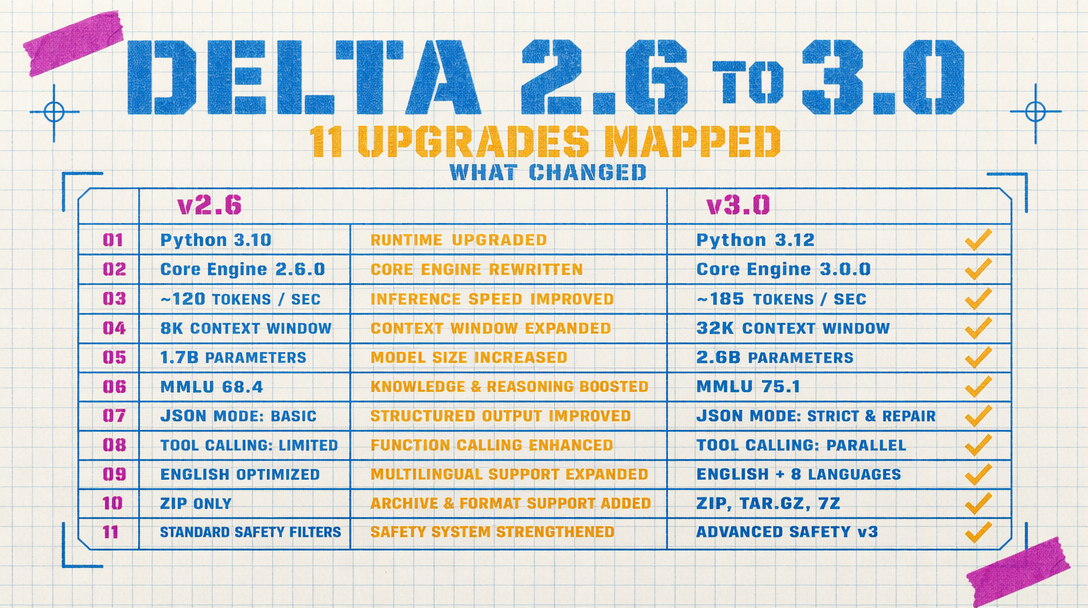
Kuaishou dropped Kling 3.0 on February 4, 2026, and if you were still shipping on 2.6 Pro, you are now two rank tiers behind. 2.6 Pro sat at Elo 1195 and rank 20 on the video arena. 3.0 Pro lands at Elo 1247 and rank 3. That is a +52 jump inside one generation, which is larger than the gap between 2.0 and 2.6 combined. Below is the honest rundown of what actually changed and where the new tier earns its price.
Unified multimodal architecture
This is the headline. Kling 3.0 is the first in the series to run a single multimodal backbone for text, image, and audio conditioning. On 2.6 you had separate T2V and I2V graphs and the audio was a post process bolted on top. In 3.0 the audio token stream is generated alongside the video tokens, which is why lip sync no longer drifts past second 8 like it did on 2.6 Pro.
Practical consequence: prompt adherence on image-to-video with a reference jumped hard. You can now push a slightly off angle reference and get the subject's face to hold through a camera arc. On 2.6 the same reference drifted by frame 90.
Duration went from 10 to 15 seconds
2.6 capped at 10s and most teams stopped at 5s because the back half of a 10s clip on 2.6 got soft. 3.0 accepts 3 to 15 seconds in one second increments with the default at 5. The quality holds deep into second 12 if your prompt is stable. Beyond second 13 you start to see motion plateau on Standard. Pro holds.
Pricing math matters here. A 10s v3 Pro text to video with no audio is 10 x $0.112 = $1.12. The same 10s on 2.6 Pro was $0.80. You are paying 40 percent more for Pro on Pro, but you are also getting one rank tier.
Native audio in CN, EN, JP, KR, ES
You no longer ship a silent clip and run MMAudio afterward. Pass audio_enabled: true and Kling generates synced dialogue, foley, and music inside the same call. Five languages with regional accents at launch. The audio surcharge on v3 Pro T2V is $0.056/s, bringing it to $0.168/s total. Five second clip with audio on: 5 x $0.168 = $0.84.
If you also want voice control (exact speaker tone, pitch, timing anchors), add another $0.028/s. That brings Pro T2V to $0.196/s. Ten second voice-controlled Pro clip: $1.96.
Multi-shot storyboarding up to 6 shots
2.6 was one shot per call. 3.0 lets you chain up to 6 shots inside a single generation, each with its own duration, size, perspective, and camera directive. The shots array feeds in order and the model carries subject identity across cuts. This is the feature that changes what you can ship in a single API call, because on 2.6 you were stitching 3 separate renders in post.
1import { fal } from "@fal-ai/client";23fal.config({ credentials: process.env.FAL_KEY });45const result = await fal.subscribe("fal-ai/kling-video/v3/pro/text-to-video", {6 input: {7 prompt: "a ceramicist pulls a tall vase on a wheel, camera arcs slowly around the bench",8 duration: 10,9 aspect_ratio: "16:9",10 cfg_scale: 0.5,11 audio_enabled: true,12 audio_language: "en",13 negative_prompt: "blur, distort, and low quality"14 },15 logs: true16});1718console.log(result.data.video.url);
What did not change
The rough spots from 2.6 are still there in 3.0. Crowded scenes (5+ subjects) still degrade. Fine motor work (typing fingers, guitar fretting, chopstick grip) still glitches. Small text in frame still warps. Fluid and fire sim at extremes still break. Video-reference motion learning is not available and there is no audio input mode.
Your upgrade call
If you ship five second clips without audio, 2.6 Pro is still defensible on cost. The second you want 10 to 15 seconds, audio, or multi-shot, 3.0 Pro is the only choice. The Elo gap alone makes it worth the cost of one failed render per week.